
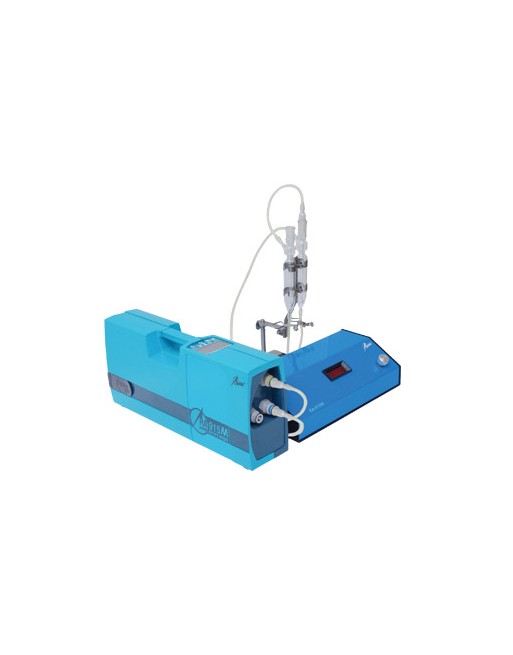


Reference : RA-915M/PYRO-915+
RA-915M mercury analyzer with RP-92 attachment is used for determination of mercury concentration in liquid samples (water, blood, urine).
RP-92 attachment is intended to transfer bound Hg from ion to atomic form using “cold vapor” technique.
| Detection limit (µg/l) | Sampling (ml) | |
| Water | 0.0005 | 20 |
| Blood | 0.5 | 1.5 |
| Urine | 0.05 | 1 |
Measurement procedure
Preliminary mineralization should be carried out by accepted procedure (ISO 5667, 7470, etc.).
Add reduction solution into the bubbler. When integration is on after stabilization of an analytical signal, insert mineralized sample into the reaction vessel. Integration will be finished when the analytical signal goes back to the baseline. Results of analysis of a blank sample should be taken into account.
Is based on the absorption of the 254-nm resonance radiation by mercury atoms using Zeeman correction for background absorption.
RA-915M mercury analyzer with RP-92 attachment can be used in ecology, sanitary, medicine, and geological-geochemical survey.
Control of mercury content in:
Occupational pathology and toxicology surveys:
Mercury pollution monitoring:
Size and weight of analyzer : 460x210x110 mm, 7.5 kg
Size and weight of RP-92 : 340x240x120 mm, 4 kg
Power requirements for analyzer : 100/240 Vac, 50/60 Hz, 15 W
Power requirements for RP-92 : 100/240 Vac, 50/60 Hz, 20 W

LEARNING OBJECTIVES
Examples of mercury determination in soil, crude oil, naphtha, wastewater, food, coal, sorbent traps, cosmetics, etc. Improving selectivity and sensitivity analysis using ZAAS Compliance with ASTM, ISO, and US EPA standards Determination of mercury species in samples.
For over 25 years, Lumex Instruments has been developing and manufacturing laboratory and industrial analysis equipment and instruments. We are pleased to offer you both ingenious traditional and new solutions, unique technologies and classic equipment, reliable established applications and innovative methods.
We combine high quality standards with a flexible and personalized approach to find perfect solutions. We are proud to deliver our products and services worldwide and we enjoy working with our valuable customers and partners in many sectors and countries.

Reference : RA-915M/PYRO-915+
RA-915M Mercury Analyzer with pyrolyzer PYRO-915+ (with large optical length of analytical cell and heated windows of the analytical cell is developed for unique direct mercury determination (no pretreatment procedures required) in complex organic samples at the level of few µg/kg.
Using of RA-915M spectrometer with background correction and a developed two-chamber catalyst atomizer PYRO-915+ allows direct analysis of complex-matrix samples.
PYRO-915+ atomizer consists of two chambers. The first is for evaporation of liquid and pyrolysis of solid samples. The second chamber is continuously heated about 800°C. There, all mercury compounds are dissociated and smoke and interference compounds are burst.
The power supply unit of the attachment provides stable air flow speed and temperature of chambers and analytical cell.

Reference : RA-915 LAB
RA-915 Lab is the new direct fully automated laboratory mercury analyzer with 45 position autosampler. It provides accurate, reliable and cost-effective measurements in the broadest range of applications areas. The instrument analyzes solid, semisolid, and liquid samples with no pretreatment, reagents and almost no wastes. RA-915 Lab can be supplied without autosampler.

Reference : RA-915F

Reference : LIGHT-915M2
Light-915M2 is a compact, portable mercury analyzer designed for convenient direct Hg measurement in air. High accuracy and real-time operation along with small size and weight make it an excellent device for field work.

Reference : RA-915M
The mercury analyzer RA-915M is a unique all-purpose high sensitivity analytical instrument for measuring mercury, especially for the real time detection of mercury vapor in air, mercury detection in water, natural and stack gases, oil and condensate, solid and sediments, foodstuff and so on.
RA-915M Mercury Analyzer is a portable multifunctional atomic absorption spectrometer with Zeeman background correction, which eliminates the effect of interfering impurities. It is the only high sensitivity and selectivity instrument that does not require gold amalgam pre-concentration and subsequent regeneration steps. This enables the user to conduct real time monitoring and detection of mercury vapor. Being combined with an RP-92 Cold Vapor accessory for water and PYRO-915+ pyrolysis attachment for solid sample testing, the instrument is designed to determine mercury content in ambient air, water, soil, natural and stack gases, dental and medical testing and diagnostics, analysis of food and marine life, etc.
Reference : RA-915M/PYRO-915+
RA-915M mercury analyzer with RP-92 attachment is used for determination of mercury concentration in liquid samples (water, blood, urine).
RP-92 attachment is intended to transfer bound Hg from ion to atomic form using “cold vapor” technique.